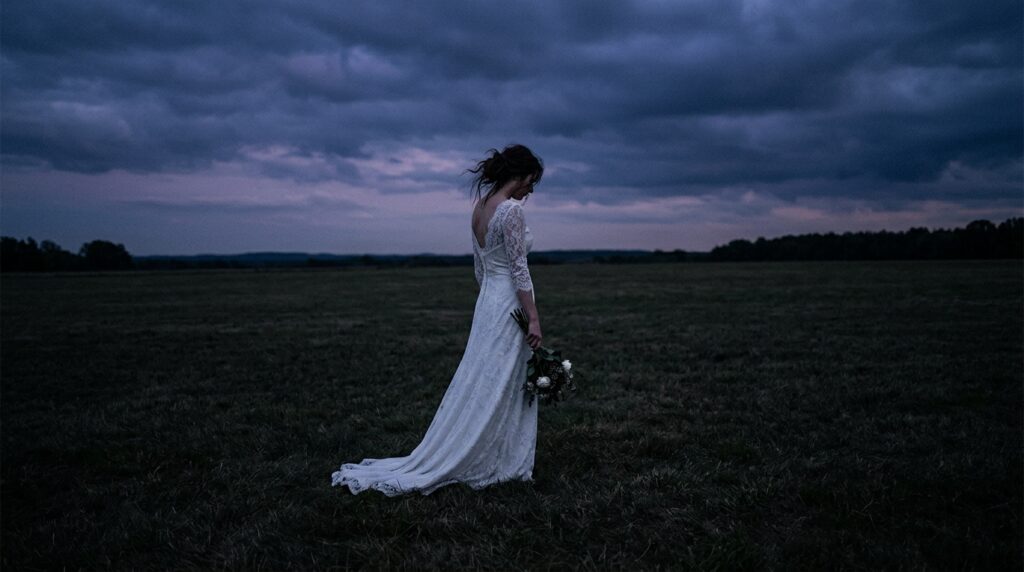
Lars von Trier’s film does not dramatize depression. It inhabits it — with a precision that no clinical description has quite matched. What it shows is not what most people think depression looks like.
About the film:Melancholia (dir. Lars von Trier, 2011) follows two sisters — Justine and Claire — in the days surrounding Justine’s wedding and the approach of a rogue planet on a collision course with Earth. This article discusses the full arc of the film. The ending is central to the psychoanalytic reading.
There is a scene early in the film that I return to more than any other.
Justine is at her own wedding reception. The room is full, the music is playing, the people who love her are present. By every external measure, something wonderful is happening. And she is lying in a sand trap on the golf course, alone, looking up at the sky, unable to explain to anyone — including herself — why she cannot be inside.
The incapacity is total. Not selective, not situational. The beauty of the occasion has reached her and produced nothing. The effort required to perform the appropriate response has exceeded what was available. She is not sad about anything in particular. She is simply unable to not be this.
I recognized that scene before I had words for what I was recognizing. I had seen it from the inside.
The dangerous truth Melancholia reveals about depression is that depression is not, primarily, an emotional state. It is a state of disconnection — a severance between the self and the world that renders the ordinary machinery of meaning, motivation, and response temporarily inoperative. It does not feel like sadness. It feels like the absence of the capacity to feel anything that was previously available — including, crucially, the capacity to feel that things matter.
This is what makes Melancholia the most psychoanalytically precise depiction of depression available on screen. Not because von Trier dramatizes the suffering — he barely does — but because he shows the specific quality of the experience: the way it sits alongside ordinary life without being produced by anything ordinary life has done, and the specific relationship it establishes between the person experiencing it and everyone around them who cannot understand why it is happening.
The Dangerous Truth Melancholia Reveals — Depression Without a Reason
The question everyone asks Justine throughout the first half of the film is a variation of the same question: why? Why can’t you just try? Why can’t you be happy — it’s your wedding, you have everything, there is no reason for this. The question is asked with love, with frustration, with genuine incomprehension. And Justine has no answer that satisfies anyone, including herself.
This is the most accurate thing the film does. The depression it depicts is not reactive — it is not produced by a loss, a trauma, a specific event that could, if identified, explain the incapacity and point toward its resolution. It is endogenous: arising from within, without a sufficient external cause, in a way that makes it inexplicable to the people around her and morally incomprehensible to the cultural framework that expects suffering to have a reason.
The most isolating feature of depression is not the suffering. It is the inability to produce a reason for the suffering that other people find adequate — and the consequent experience of being held responsible for something that is not a choice.
The planet Melancholia — the rogue planet approaching Earth on a collision course — is the film’s central metaphor, and it is more precise than it initially appears. The planet arrives regardless of what anyone does. It cannot be argued with, managed, or deflected by effort or will. It simply comes. And what von Trier is showing, with the planet, is what depression feels like from the inside: not something that happens to you in response to circumstances, but something that arrives on its own schedule, from its own trajectory, indifferent to what your life currently contains.
Freud’s Mourning and Melancholia — What the Clinical Framework Explains
Freud’s 1917 essay “Mourning and Melancholia” remains the most illuminating psychoanalytic account of what the film is depicting. Freud distinguished mourning — the normal grief process that follows an identifiable loss — from melancholia, which shares mourning’s features (withdrawal, loss of interest, inability to engage with the world) but lacks the identifiable object. In mourning, you know what you have lost. In melancholia, the loss is unconscious — the person cannot say what they are grieving because the object of the grief is not available to conscious awareness (Freud, 1917).
What Freud identified as the structural feature of melancholia that distinguishes it from mourning is the turning of aggression against the self. In mourning, the ambivalence toward the lost object — the love and anger that any significant attachment contains — is directed outward, toward the loss. In melancholia, it is redirected inward. The harsh self-criticism, the diminishment of self-worth, the sense of worthlessness that accompanies severe depression is, in the Freudian account, the anger that cannot find its proper object being turned against the self instead.
Justine’s self-criticism in the film is not prominent — von Trier is not interested in the theatrical version of depression — but it is present in the specific quality of her resignation. She does not defend herself against the accusations of the people around her. She does not explain that she is not choosing this. She absorbs the criticism with a flatness that is itself a symptom: the self that has been so thoroughly turned against that it no longer registers the difference between being attacked from outside and being attacked from within.
What the Research Finds in the Experience the Film Depicts
Contemporary depression research has increasingly moved away from the purely biochemical model toward what researchers call the network theory of depression — an account in which depression is understood as a self-sustaining system of mutually reinforcing symptoms, each of which makes the others worse (Borsboom & Cramer, 2013). The inability to experience pleasure makes engagement impossible. The inability to engage produces withdrawal. Withdrawal increases the inability to experience pleasure. The network becomes self-sustaining.
What this research finds — and what the film shows with unusual accuracy — is that once the depressive network is activated, it tends to persist independently of the circumstances that may have activated it. The external circumstances can improve while the network continues running. This is what produces the experience of depression without a reason: the circumstances no longer justify the state, but the state has its own momentum.
Research on what Nolen-Hoeksema called rumination — the repetitive, passive focus on negative feelings and their possible causes — has found that it is one of the most reliable predictors of depression onset and maintenance (Nolen-Hoeksema, Wisco, & Lyubomirsky, 2008). What characterizes Justine’s depression in the film is not rumination in this sense — she is not actively thinking about her suffering. She is simply unable to access the states that would allow her to be otherwise. The absence is more total than rumination describes.
The research that most directly maps onto what the film shows is on anhedonia — the specific inability to experience pleasure that is considered a core feature of major depression. Anhedonia is not sadness. It is the absence of the capacity for positive response to stimuli that would normally produce it. The wedding, the music, the people who love her — these reach Justine and produce nothing. That is anhedonia. And it is, as the film shows, not a choice and not a response to what is happening. It is a state the person is in.
What the Second Half of the Film Adds to the Psychoanalytic Picture
The film’s second half reverses the sisters. As the planet approaches and the threat becomes undeniable, Claire — who has been functional throughout the first half — begins to collapse into panic. And Justine, who has been incapacitated, becomes calm. Not recovered. Not happy. Calm — with a specific quality of equanimity that the film frames not as healing but as recognition.
What von Trier is suggesting, in this reversal, is something that psychoanalytic thought has articulated in different registers: that depression, whatever its costs, can carry a specific relationship to reality that ordinary functioning forecloses. The depressive’s inability to sustain the ordinary fiction that things are fine, that effort matters, that the future is open — this inability, which is experienced as incapacity during the depressive episode, can become, in specific circumstances, the most accurate available response.
This is not a romanticization of depression. It is a description of one of its most psychoanalytically interesting features: that the depressive’s relationship to meaning and its absence is, in some respects, more honest than the relationship most people sustain by not looking too directly at the conditions of existence. Justine has been looking directly for the entire film. When the planet arrives, she is the only one who is not surprised.
For the specific experience of a body that cannot relax — the nervous system dimension of states related to depression and anxiety — see our article on why your body never truly relaxes. And for the film that most directly addresses the family dimension of what depression conceals and what it reveals, the article on what the body holds in Sharp Objects addresses the somatic memory that depression often carries.
The Planet Was Always Coming
I watched Melancholia for the first time during a period when I could not have explained to anyone why I was not able to do the things I was not doing. The question everyone was asking — why? — had no answer I could provide that would have made sense to them. The incapacity was total and sourceless and had arrived on its own schedule, indifferent to what my life currently contained.
The film did not explain it. But it showed it — with an accuracy that I had not encountered anywhere else, in any medium. The sand trap. The wedding. The planet. The specific quality of the absence.
The dangerous truth Melancholia reveals about depression is not that it is dramatic or romantic or explainable. It is that it arrives without asking permission and without providing a reason that satisfies anyone — including the person experiencing it. And that the absence of a sufficient reason is not evidence that nothing real is happening. It is evidence that what is happening does not require a reason to be real.
References
Borsboom, D., & Cramer, A. O. J. (2013). Network analysis: An integrative approach to the structure of psychopathology. Annual Review of Clinical Psychology, 9, 91–121. https://doi.org/10.1146/annurev-clinpsy-050212-185608
Freud, S. (1917). Mourning and melancholia (J. Strachey, Trans.). In The standard edition of the complete psychological works of Sigmund Freud (Vol. 14, pp. 237–258). Hogarth Press.
Nolen-Hoeksema, S., Wisco, B. E., & Lyubomirsky, S. (2008). Rethinking rumination. Perspectives on Psychological Science, 3(5), 400–424. https://doi.org/10.1111/j.1745-6924.2008.00088.x
On the Channel · Published 21 June 2026
This article examines what Melancholia reveals about depression that clinical descriptions rarely capture — the specific quality of the absence, the way it arrives without a reason that satisfies anyone, and what the film’s second half adds to the psychoanalytic picture. The video goes deeper into von Trier’s formal choices: why he shoots the wedding the way he does, what the planet is doing as a metaphor, and what the reversal of the sisters in the second half says about the relationship between depression and reality.Melancholia: the sadness that has no name and finds no way out. — Hidden Patterns
📖 If You Want to Go Further
The book that most directly addresses the psychoanalytic framework this article draws on — and the one that remains the most honest account of what depression feels like from the inside — is Andrew Solomon’s The Noonday Demon: An Atlas of Depression. Solomon writes from personal experience and from decades of research, and what he captures — the specific quality of the absence, the impossibility of explaining it to people who have not experienced it, the way it sits alongside ordinary life without being produced by anything ordinary life has done — is the same territory the film inhabits. It is the book I would give to anyone who has experienced what Justine experiences, or who loves someone who has.