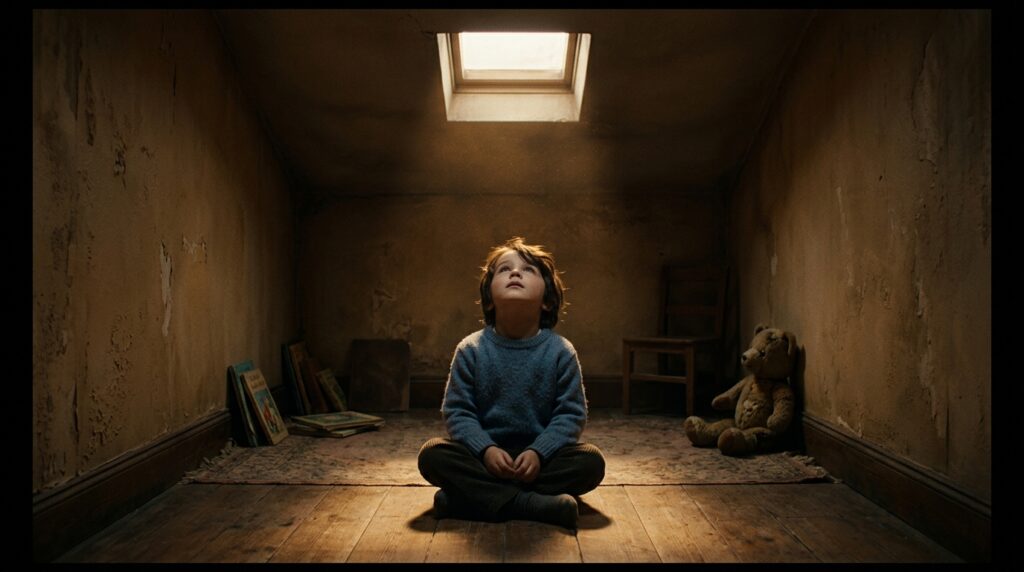
Inception is not a film about dreams. It is a film about the structure of the unconscious — and what Freud would have seen in each layer is considerably more disturbing than what the film’s plot suggests.
About the film:Inception (dir. Christopher Nolan, 2010) follows Dom Cobb, a thief who extracts information from people’s dreams. The film’s central mission involves planting an idea — rather than extracting one — in the deepest layer of a target’s unconscious. This article discusses the full arc of the film, including its ending and the significance of the totem.
The question everyone asks at the end of Inception is whether the top falls.
Whether Cobb is still dreaming. Whether what we have been watching him experience as reality is another layer of the dream — whether the return home, the children’s faces, the entire resolution of the film’s emotional arc occurs inside an unconscious that never fully woke.
It is the right question. But it is not the most disturbing one the film raises. The more disturbing question — the one that Freud would have gone straight to — is not whether Cobb is dreaming at the end. It is what Mal is doing in every layer. What she represents. And why Cobb cannot go deeper without her arriving.
The answer to that question is the film’s actual psychoanalytic content. And it is more precise than the film itself seems to know.
The dangerous truth Inception reveals about the unconscious is not that it is organized in layers — though it is, and the film’s architecture maps onto the psychoanalytic account with surprising precision. It is that the deepest layer is not the one that contains the target’s secret. It is the one that contains the operative’s — the layer where what Cobb has buried lives, and where his capacity to function in all the other layers is continuously threatened by what he has refused to process.
This is not a reading imposed on the film from outside. It is the film’s own architecture, followed to its logical conclusion. Inception is a psychoanalytic film that does not know it is a psychoanalytic film — which is what makes the reading so productive.
What Freud Would See in Each Layer
LAYER 1 — THE DREAM
The Preconscious — What Can Be Accessed With Effort
The first layer of the dream corresponds to what Freud called the preconscious — the material that is not in conscious awareness but can be accessed with relatively little effort. It is the layer of the target’s ordinary mental life, the contents available just below the surface. The extraction that occurs here is relatively straightforward: the information is present, it requires technique to access, but it is not deeply defended. The architecture of the dream reflects the dreamer’s ordinary associations — cities, buildings, social contexts — rather than deeply personal material.
LAYER 2 — DEEPER
The Personal Unconscious — The Protected Material
The second layer corresponds to the personal unconscious — the material that is more deeply defended, that requires more significant intrusion to access, and that the dreamer’s projections begin to guard more actively. The militarized projections that attack the extraction team in deeper layers are the film’s representation of what psychoanalysis calls resistance — the unconscious defense mechanisms that protect the psyche’s most significant material from external access. The defenses become more organized and more aggressive the deeper the team goes — precisely as resistance intensifies when the therapeutic process approaches more significant material.
LAYER 3 — THE DEEPEST
The Core Complex — The Organized Defense
The third layer is where the film’s target material lives — the relationship with the father, the wound that the inception is designed to address. In Freudian terms, this is the complex: the organized cluster of emotionally charged memories, fantasies, and affects around a significant relationship that has determined the person’s psychological structure. The inception — the planting of the idea that the father wanted the son to be his own man — is, in psychoanalytic terms, a therapeutic intervention: the reorganization of the complex around a more adaptive interpretation of the formative relationship.
The film’s most psychoanalytically precise insight is not the layered structure of the dream. It is Mal. She is not a character. She is a projection — the externalization of Cobb’s unprocessed grief, inhabiting every layer of the dream as the return of what was repressed.
What Mal Is — And What Freud Would Have Called Her
Mal is the film’s most psychoanalytically significant element — and the one that is most consistently misread as a plot device rather than a structural feature. She is not Cobb’s wife appearing in his dreams. She is Cobb’s unconscious — specifically, the part of his unconscious that contains his unprocessed grief, his guilt about her death, and his refusal to complete the mourning that her loss requires.
Freud’s account of mourning and melancholia — the distinction between the successful processing of a loss and the pathological internalization of the lost object — describes precisely what Mal represents (Freud, 1917). In mourning, the lost object is gradually relinquished — the libido detaches from the representation of the lost person and becomes available for reinvestment in new objects and experiences. In melancholia, the lost object is not relinquished but internalized — incorporated into the ego in a way that preserves its presence at the cost of the ego’s functioning. Mal is Cobb’s melancholia. She is the lost object that was not mourned — that was incorporated rather than relinquished — and that now inhabits his unconscious as a permanent saboteur of his functioning in every layer of the dream.
The specific form her sabotage takes is the film’s most psychoanalytically precise detail. Mal does not simply appear as a memory or a longing — she appears as an agent, with her own goals, her own logic, her own capacity to act independently of Cobb’s wishes. This is exactly what the incorporated object does in melancholia: it takes on an autonomous life within the psyche, operating according to the logic of the lost relationship rather than the logic of the current situation. Mal follows the rules of the relationship Cobb had with his wife — she demands his presence, she resists his departure, she sabotages his capacity to function independently of her — because she is not his wife. She is his internalized representation of his wife, running the relationship’s program in the absence of the actual person.
The Totem — And the Question It Cannot Answer
The totem — the spinning top that tells Cobb whether he is in a dream or in reality — is the film’s most philosophically resonant device and its most psychoanalytically honest one. The totem is Cobb’s reality-testing instrument: the external object that provides what his own perceptual and cognitive systems cannot reliably provide, which is a definitive answer to the question of whether what he is experiencing is real.
But there is a problem with the totem that the film acknowledges obliquely and that the psychoanalytic reading makes explicit: the totem was Mal’s. It was her reality-testing instrument — her way of distinguishing the dream from the real. When Cobb took it after her death, he took the instrument that belonged to the person he is still dreaming about, in a state of mind that the film itself identifies as potentially compromised. A reality-testing instrument that belongs to the incorporated lost object — that was designed to answer questions about the real for someone who is now part of the unreal — is not a reliable guide to the distinction it is supposed to provide.
This is why the film ends without showing whether the top falls. The question of whether Cobb is dreaming cannot be answered by the totem — because the totem itself is part of the problem. The only reliable reality test would be the completion of the mourning process: the relinquishment of Mal as an internal object, the detachment of the libido from her representation, the freedom to experience the present without her as a permanent presence. The children at the end of the film — if Cobb is genuinely awake — are evidence not that the top falls but that something more fundamental has shifted: that the mourning has been sufficiently completed that he can finally see their faces without her standing between them.
What the Film Gets Right That Most Accounts of Dreams Get Wrong
The most common account of dreams treats them as messages — as communications from the unconscious that contain symbolic content waiting to be decoded. This account is partially correct but fundamentally incomplete. What Inception gets right — even without fully knowing it is getting it right — is that the dream is not primarily a message. It is an environment: a space in which the unconscious’s unprocessed material takes architectural form, shaping the dreamer’s experience from the inside rather than communicating with the dreamer from the outside.
Mal does not appear in Cobb’s dreams to tell him something. She appears because she is the organizing principle of the layer she inhabits — because the unprocessed grief has become so structurally central to Cobb’s unconscious that it cannot be excluded from any environment that his unconscious generates. She is not a message about his grief. She is his grief, in architectural form, shaping every layer of the dream from within.
This is what makes the film’s psychoanalytic reading more disturbing than its plot. The plot suggests that the problem is external — a mission to be completed, an obstacle to be overcome, a reality to be returned to. The psychoanalytic reading suggests that the problem is structural — that what Cobb is navigating in the dream is not a series of external challenges but the architecture of his own unconscious, organized around a loss he has not been able to mourn. And that the only exit from that architecture is not the completion of the mission but the completion of something more fundamental: the work of letting go of what was lost.
For the broader account of what dreams are doing and why the unconscious keeps returning to the same material, see our article on why your recurring dream never stops. And for the film that most directly addresses what happens when the internalized object takes over the self entirely — the dissociated version of what Mal represents in Inception — the article on why hidden rage creates someone else inside you addresses the same structure in Fight Club.
The Top Was Never the Point
Everyone wants to know if the top falls. Whether Cobb is awake or dreaming. Whether the resolution is real.
The psychoanalytic reading suggests that this is the wrong question — or rather, that it is the surface question, the one the film invites you to ask so that you will stay with the more disturbing one underneath it. The more disturbing question is not whether Cobb is dreaming. It is why Mal is always there when he goes deeper. Why the defenses intensify around her presence. Why every layer of the dream contains her — not as a memory, not as a presence from the past, but as a current organizing force that shapes the architecture of every environment his unconscious generates.
The dangerous truth Inception reveals about the unconscious is this: it does not store the past as archive. It stores the past as structure — as the organizing principle of the environments it generates, the defenses it deploys, the saboteurs it positions in every layer between the present self and anything that would require the past to be genuinely relinquished. The top was never the point. Mal was always the point. And the question the film is really asking — the one that does not end when the credits roll — is not whether Cobb is dreaming. It is whether he is finally ready to let her go.
REFERENCES
Freud, S. (1900). The interpretation of dreams (J. Strachey, Trans.). In The standard edition of the complete psychological works of Sigmund Freud (Vols. 4–5). Hogarth Press.
Freud, S. (1915). The unconscious (J. Strachey, Trans.). In The standard edition of the complete psychological works of Sigmund Freud (Vol. 14, pp. 159–215). Hogarth Press.
Freud, S. (1917). Mourning and melancholia (J. Strachey, Trans.). In The standard edition of the complete psychological works of Sigmund Freud (Vol. 14, pp. 237–258). Hogarth Press.
ON THE CHANNEL · PUBLISHED 12 JULY 2026
This article examines what Freud would have seen in each layer of Inception — from the preconscious first layer to the core complex of the third — and what Mal actually is in psychoanalytic terms. The video goes deeper into the totem’s specific problem, why it cannot answer the question it was designed to answer, and what the film’s ending is actually showing about the completion of the mourning process.Inception — Dreams within dreams and what Freud would see in every layer.
📖 IF YOU WANT TO GO FURTHER
The book that most directly addresses the psychoanalytic account of dreams — what they are doing, how the unconscious structures them, and why the same material keeps appearing — is Freud’s own The Interpretation of Dreams. It is long and occasionally dated in its specific interpretations, but Part VII — the theoretical chapter on the structure of the psychic apparatus — is the most precise account available of what Inception is depicting architecturally, and reading it alongside the film produces a doubling of both that neither alone achieves.