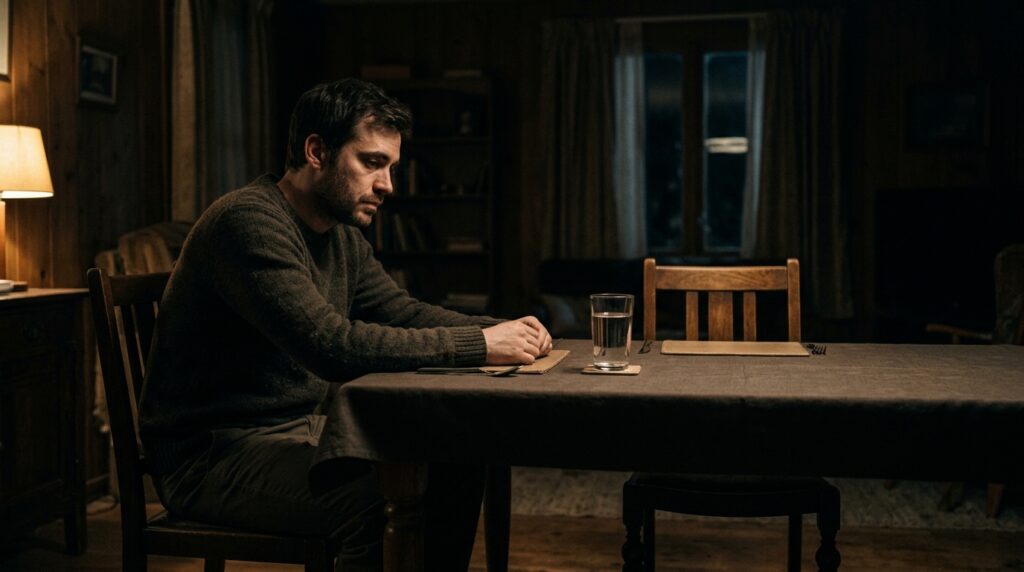
You look back at the decades and something doesn’t settle. Not grief, not regret exactly — something quieter. The question of whether you were ever really there.
My grandmother kept a box of letters she never sent. I found it after she died — a shoebox under her bed, held together with a rubber band that crumbled when I touched it. Inside were pages of careful, controlled handwriting addressed to people who were still alive. Her sister. An old friend from before the marriage. Someone whose name I didn’t recognise. She had never sent them. She had written them over decades and put them away. I don’t know if she thought of them often. But I know that at the end, she was quiet in a way that wasn’t peace. I think about that box when I think about what it means to look back.
There is a particular kind of stillness that arrives in the later years of a life — not the stillness of rest, but the stillness of inventory. You stop moving long enough to look at what you built, what you kept, what you left behind. And sometimes what you find is not what you expected.
Not failure. Not regret in the dramatic sense. Something harder to name: a quiet suspicion that somewhere along the way, you were the custodian of your own life rather than the one living it.
The Audit Nobody Asked You to Do
It tends to arrive in small moments. Sitting in a kitchen that suddenly feels too large. Looking at a photograph and noticing the expression you were wearing — the one that was appropriate for the occasion but not quite yours. Hearing a song that returns you to a version of yourself you set aside for reasons that felt necessary at the time.
You aren’t asking whether your life was bad. Many people who carry this question had lives that were, by most visible measures, perfectly decent. Stable work. A family that held together. Responsibilities met. And yet.
There is something that the responsible life — the life of custodianship, of managing the family system, of being the reliable one — tends to quietly cost. It costs the moments of genuine desire that you edited out because they were inconvenient, or risky, or simply not what was expected of you. It costs the voice you kept at a certain volume to keep the peace. It costs the choices you didn’t make because the weight of other people’s need was heavier than your own.
You were present. But were you ever truly the protagonist of your own story?
This is not a question that arrives with accusation. It arrives, for most people, with a kind of sorrow that is surprisingly gentle — the sorrow of finally having enough stillness to hear it.
The Self That Was Left Waiting
When I first encountered Erik Erikson’s concept of ego integrity versus despair — the final stage of his theory of psychosocial development — I was struck by how little it resembles what people actually experience when they look back.
Erikson described this stage as the point at which a person either arrives at a sense of coherence about their life — an acceptance of the choices made, the paths taken, the self that emerged — or falls into despair at what was not done, not lived, not claimed (Erikson, 1968). The language is almost judicial: you either pass or you don’t.
But what I see in the people who carry this question is something more nuanced than a verdict. It is closer to what Winnicott described as the false self — the organised, adaptive, functional version of a person that develops in response to what the environment required, while the true self, the one with genuine desire and spontaneous aliveness, learns to stay quiet (Winnicott, 1965).
The unsettled feeling of looking back is not always despair. It is sometimes the true self, patient after decades, finally making itself heard. Not to punish. To be acknowledged.
That box of unsent letters was not evidence of a failed life. It was evidence of a self that had kept living, quietly, in the margins — waiting for enough space to be seen.
What the Research Shows — and Where It Falls Short
The clinical literature on life review has grown considerably since Robert Butler first named it in 1963 as a universal psychological process in late life — one in which the ageing person spontaneously reviews their past, often with increasing vividness and emotional weight (Butler, 1963). Subsequent research has confirmed that structured life review — guided reflection on one’s personal history — is associated with reduced depressive symptoms and increased psychological wellbeing in older adults (Haight & Webster, 1995).
That data matters. It tells us that the impulse to look back is not pathological — it is developmental. It belongs to this stage of life as naturally as physical growth belongs to childhood.
What the research measures less well is the particular quality of unrest in people who feel they were never quite present in their own lives. The studies tend to focus on traumatic memories, on regret over specific events. They are less equipped to capture what it feels like to look back at a life that was, on paper, absolutely fine — and still find something missing.
That gap between the data and the lived experience is, in my view, exactly where the real work happens. The questionnaire can measure satisfaction. It cannot measure the distance between the self you were and the self you might have been, had the conditions been slightly different.
Naming It Doesn’t Fix It. But It Changes Something.
What shifts when you recognise this pattern — the pattern of having lived responsibly, reliably, usefully, and perhaps not entirely as yourself — is not the past. The past is fixed. What shifts is your relationship to the inventory.
There is a difference between looking back as a judge and looking back as a witness. The judge weighs the evidence and returns a verdict. The witness simply sees what happened — the conditions you were working with, the resources you had, the things you were trying to protect, the calculations you were making as best you could with what you understood at the time.
Understanding that you lived a survival strategy rather than a lie does not erase the cost of it. But it changes what you do with the recognition. A verdict closes. A witness stays with what they saw.
My grandmother’s letters were not a failure of courage. They were evidence of someone who had more interior life than the surface of her days ever reflected — and who, in her own way, kept it alive. I cannot know what she thought about them at the end. But I know they existed. And I think that matters.
The Question Itself Is a Form of Presence
There is a late-afternoon quality to this question — the light at a particular angle, the world at a particular volume. And there is, I think, something important in the fact that it comes when it does.
The person who never paused long enough to ask whether they really lived is not asking the question. You are. That means something. The ache of looking back and not being sure is not a sign that you wasted your life. It is a sign that the part of you that wanted more — that always wanted more — is still there, still present, still making its case.
The box of unsent letters is still under the bed. But you know it’s there now.
References
Butler, R. N. (1963). The life review: An interpretation of reminiscence in the aged. Psychiatry: Journal for the Study of Interpersonal Processes, 26(1), 65–76. https://doi.org/10.1080/00332747.1963.11023339
Erikson, E. H. (1968). Identity: Youth and crisis. W. W. Norton.
Haight, B. K., & Webster, J. D. (Eds.). (1995). The art and science of reminiscing: Theory, research, methods, and applications. Taylor & Francis.
Winnicott, D. W. (1965). The maturational processes and the facilitating environment. International Universities Press.
On the Channel
This article opens the question of life review — what it is, why it arrives when it does, and what psychoanalysis says about the self that got left waiting. The video goes further into the specific emotional structure of this stage: the ideal you carried your whole life, and what happens when you finally let yourself measure your history against it.I Look Back… And I Don’t Know If I Lived Right — Hidden Patterns
📖 If You Want to Go Further
The book that sits closest to what this article is trying to say is From Age-ing to Sage-ing by Zalman Schachter-Shalomi and Ronald S. Miller. It takes the life review process seriously — not as therapy, not as reminiscence, but as a form of genuine reckoning with the self. It does what few books on ageing do: it treats the later years as a time of real psychological work, not just acceptance.