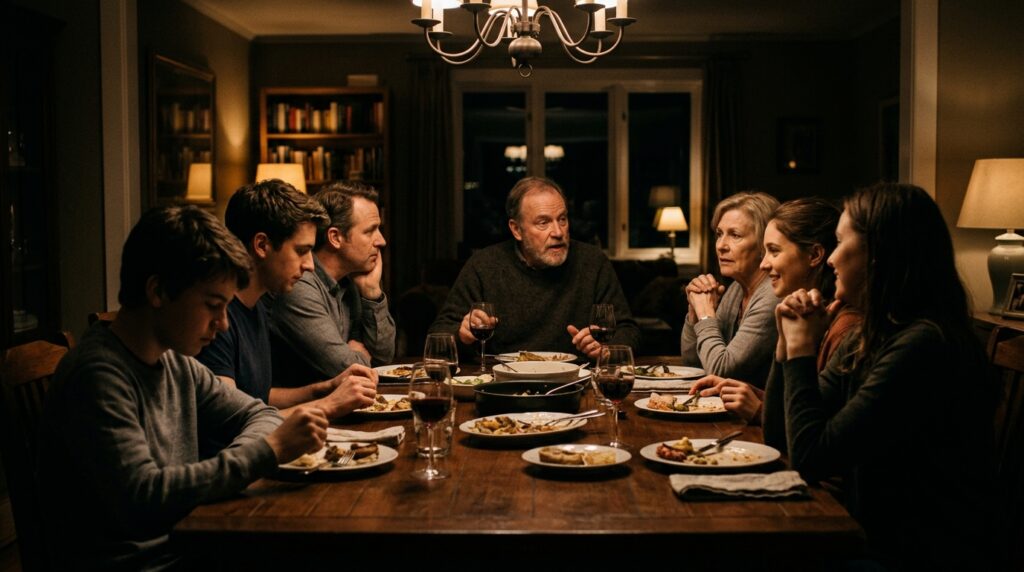
In some families, everything revolves around one person — not because they decided it consciously, but because the system built itself around them over time. All emotions, all decisions, all conflicts pass through that center. Understanding how the system works — and what it produces in the people who grow up inside it — is what this article is about.
Every family has a way of being together. A rhythm, a set of unspoken rules about who speaks and who listens, whose feelings take priority, whose needs organize the room.
In some families, that rhythm is so thoroughly organized around one person that the others have spent years — sometimes decades — adapting themselves to it without having fully named what they were adapting to. Meals are planned around that person’s preferences. Conversations are navigated around that person’s sensitivities. Celebrations are managed with that person’s reactions in mind. Crises are calibrated to that person’s capacity to tolerate them.
The person at the center is not always obviously dominant. They are not always loud or cruel or explicitly controlling. Sometimes they are simply someone who needs a great deal — whose emotional requirements are large enough that the system has reorganized itself, gradually and without a formal decision, to meet them. And the reorganization has become so complete that no one inside it can quite remember when it was otherwise.
This is the narcissistic family system. And what it produces in the people who grow up inside it is the subject of this article.
When a family revolves around one person, the structure that results is not simply an inconvenient arrangement of family dynamics. It is a developmental environment — one in which the children who grow up inside it form their earliest understandings of what relationships require, what their own needs are worth, and what the cost of having and expressing those needs will be. Those understandings do not dissolve when the children leave the family. They persist as the relational templates from which adult life is organized.
When a Family Revolves Around One Person — How the System Builds Itself
The narcissistic family system does not typically arrive fully formed. It builds itself over time, through the accumulation of small adaptations — each one individually reasonable, collectively producing a structure in which one person’s needs have become the organizing principle of family life.
The process begins with the specific requirements of the narcissistic individual. Their need for admiration, for validation, for emotional regulation provided by others — these needs are real and persistent. They do not disappear when they are not met. They intensify, producing responses — withdrawal, rage, escalating demands — that the family learns to anticipate and preempt. The family members who are most capable of meeting the narcissistic individual’s needs most effectively — the most empathic child, the most conflict-avoidant partner — become the primary providers. And their providing becomes the system’s default structure.
The narcissistic family system is not built by the narcissistic individual alone. It is built by the entire family, in response to the specific consequences of not meeting the narcissistic individual’s needs. The system is a collective adaptation to a gravitational field. And like all gravitational fields, it operates on everyone in its vicinity — whether or not they chose to enter it.
What makes the system difficult to identify from the inside is precisely that it was built through adaptation rather than imposition. The family members did not agree to organize their lives around one person’s needs. They adapted, step by step, to what the environment required. And by the time the pattern is complete enough to be visible, it has been running long enough that it feels like the natural order rather than a constructed arrangement.
Bowen’s Family Systems Theory — The Identified Patient and the Undifferentiated Mass
Murray Bowen’s family systems theory describes the narcissistic family structure with unusual precision. Bowen’s concept of the undifferentiated family ego mass — the degree to which individual family members have merged their emotional functioning with the family system rather than maintaining separate, differentiated selves — describes what the narcissistic family produces: a system in which individual emotional responses are so thoroughly organized around the central person’s needs that the family members have difficulty distinguishing their own feelings from the system’s requirements (Bowen, 1978).
The child who grows up in a narcissistic family system learns, across thousands of interactions, to monitor the central person’s emotional state before attending to their own. The question “what am I feeling?” is preceded, automatically and unconsciously, by “what is the central person feeling, and what does that require of me?” This monitoring becomes so automatic that it persists into adult life as the default mode of emotional processing — applied not only to the original family but to all subsequent relationships, and experienced not as a learned pattern but as a basic feature of how the social world works.
Bowen’s concept of differentiation — the capacity to maintain a separate sense of self while remaining emotionally connected to significant others — describes the developmental achievement that the narcissistic family system makes most difficult. The child who was required to subordinate their own emotional experience to the system’s requirements has not had the developmental conditions that differentiation requires. Their sense of self was assembled in an environment where the self’s distinctness was a liability rather than an asset — where being too clearly oneself was experienced as a threat to the system’s stability.
What Growing Up in the Narcissistic Family System Produces
Research on the adult outcomes of children raised in narcissistic family systems has identified several consistent patterns. The first is what clinicians call hypervigilance to the emotional states of others — a persistent, automatic scanning of the social environment for signals about what other people need and how to provide it, developed in response to the specific requirement of the narcissistic family system that the child’s own needs be subordinated to the monitoring of the central person’s needs (Miller, 1981).
The second is what has been described as a deficit in the sense of entitlement to one’s own experience — a difficulty, persisting into adult life, in recognizing one’s own feelings and needs as legitimate claims on the environment. The child who learned that their needs were secondary to the central person’s needs carries that hierarchy into adult relationships — experiencing their own needs as inconveniences rather than as reasonable expectations, and experiencing the assertion of those needs as a transgression rather than as a normal feature of intimate life.
The third is what Alice Miller called the drama of the gifted child — the specific pattern in which the child who was most successful at meeting the narcissistic parent’s needs became the most accomplished adapter, the most attuned emotional provider, the most capable of making the central person feel seen and valued (Miller, 1981). That child’s gifts are real. But they were developed in service of the system’s requirements rather than in service of the child’s own development — and they carry, into adult life, the specific limitation of capacities that were built for others rather than grown from the inside.
The Invisible Cost — What the System Takes Without Announcing It
The most alarming feature of the narcissistic family system is not its visible effects — the conflict, the emotional volatility, the moments of explicit demand. It is the invisible cost: what the system takes from the people who grew up inside it without any visible transaction, simply through the organization of the developmental environment.
What it takes, most fundamentally, is the developmental experience of having one’s own emotional experience treated as primary — of having one’s feelings, needs, and responses met with the same quality of attunement that the narcissistic individual’s were. The child in the narcissistic family system received attunement as a provider of attunement, not as a recipient of it. They learned, in the most formative years of their development, that the question “what do you need?” was addressed to them rather than about them.
The adult who grew up in that system typically does not experience this as a loss. They experience it as the natural order — as how relationships work, as what they are for. The deficit is structural rather than felt, which is precisely what makes it so persistent and so difficult to address without the specific kind of attention that names it for what it was.
For the specific experience of what the narcissistic parent’s envy does to the child who succeeds — the particular wound produced when the central person cannot celebrate the child’s achievements — see our article on the hidden truth about parents who envy their children. And for the account of what the narcissistic cycle looks like in intimate relationships — the idealisation, devaluation, and discard that the system produces in adult partnerships — the article on the alarming cycle narcissists use to destroy relationships addresses the same dynamic in the relational rather than the family context.
The System Was Not a Decision
The family that revolves around one person did not decide to revolve. The adaptations that produced the structure were reasonable, one by one — each one a response to something real, a management of something that needed managing. The system was built from the outside in, by people who were trying to navigate an environment they did not fully understand and could not fully name.
The children who grew up inside it did not choose the developmental environment they were given. They adapted to it with the resources they had — developing the capacities the system required, subordinating the needs the system could not accommodate, learning the specific relational logic of a world organized around someone else’s center of gravity.
The alarming truth about the narcissistic family system is not that it is malicious. It is that it is structural — that it operates on everyone inside it through the organization of the environment rather than through conscious intention, and that what it produces persists long after the family has been left behind, in the specific relational patterns of adults who learned, in their most formative years, that their own center of gravity was always going to be secondary to someone else’s.
Naming the system is not the same as blaming the person at its center. It is the beginning of the work of locating the self that was assembled around someone else’s needs — and asking, for the first time with genuine curiosity, what it might look like to build one from the inside out.
REFERENCES
Bowen, M. (1978). Family therapy in clinical practice. Jason Aronson.
Miller, A. (1981). The drama of the gifted child: The search for the true self (R. Ward, Trans.). Basic Books.
Kernberg, O. F. (1975). Borderline conditions and pathological narcissism. Jason Aronson.
ON THE CHANNEL · PUBLISHED 06 JULY 2026
This article examines the narcissistic family system — how it builds itself through adaptation rather than imposition, what it produces in the people who grow up inside it, and the specific invisible cost that it takes without announcing it. The video goes deeper into the three consistent patterns that adult children of narcissistic family systems carry into their relationships — and what the work of differentiation actually requires.The Narcissist in the Family — When the System Revolves Around Just One Person
📖 IF YOU WANT TO GO FURTHER
The book that most directly addresses the experience of growing up in a narcissistic family system — and the specific work of locating the self that was assembled around someone else’s needs — is Alice Miller’s The Drama of the Gifted Child. Miller writes about the child who adapted most successfully to the narcissistic parent’s needs — the most attuned, the most capable, the most accomplished at making the parent feel seen — and what that adaptation cost. It is the most precise account available of what the narcissistic family system takes from the child who was best at surviving it, and the most honest account of what recovery from that taking actually requires.