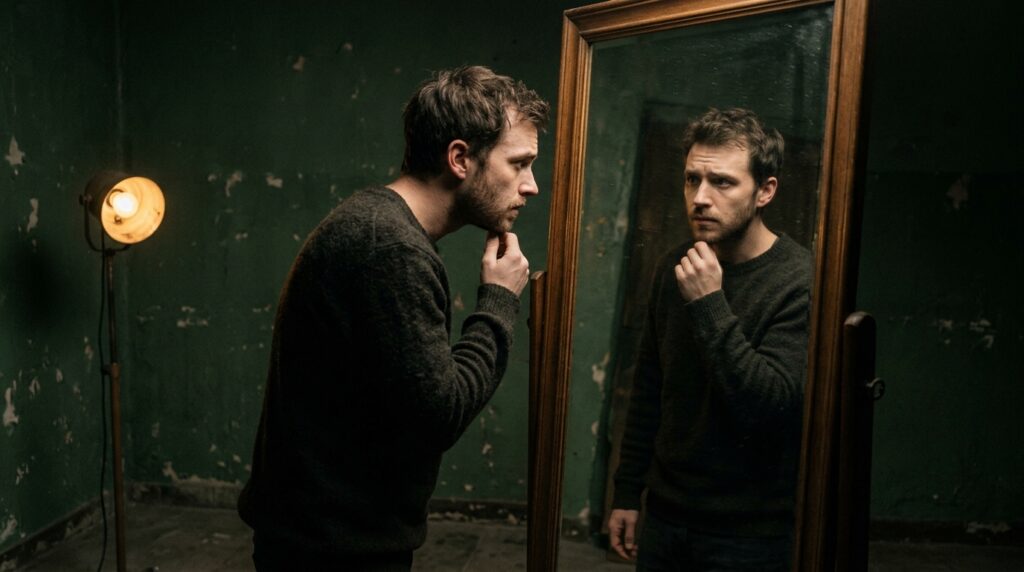
Succession is not about wealth or power. It is about what happens to children raised by a father who withholds love as a management tool — and the specific damage each of them carries into adulthood.
Note on spoilers: This article discusses the full arc of Succession (HBO, 2018–2023), including the final season. The psychoanalytic reading depends on the complete picture of all four Roy children and Logan’s relationship to each of them. If you haven’t finished the series, the analysis will be considerably more useful after you have.
My father said “I love you” exactly once that I can remember.
Not because he didn’t feel it. I believe he did, in his way — in the particular way of men of his generation and background for whom love was demonstrated through provision and presence rather than through words. The words themselves were not in his vocabulary for this. They were available. He simply never deployed them.
I understood this, intellectually, from an early age. I understood that his silence was not withholding. And I also understood — or rather, felt, in the way children feel things before they have language for them — that the understanding made no difference to what the silence cost.
Succession is about the cost of a different kind of silence. Not absence of affection but the strategic deployment of its withholding. Logan Roy does not lack the capacity to express love. He understands, with considerable precision, exactly what its withholding does to his children. And he uses that understanding.
Four seasons of Succession have been misread, repeatedly, as a story about power — about who will inherit the Roy empire, about the machinations of the ultra-wealthy, about the corruption that follows money across generations. These readings are not wrong. They are surface readings of a series whose real subject is something that requires no empire to be relevant: what it does to a child to grow up in a family where love is conditional, where approval is the scarce resource around which everything organises, where the parent has understood — consciously or not — that withholding is a more effective management tool than giving.
Every significant behaviour in Succession — every betrayal, every alliance, every humiliation — is explicable as a response to this single condition. The empire is the context. The father is the cause.
The Four Strategies for an Unwinnable Game
What makes Succession unusually precise as a psychological portrait is that it shows not one response to a narcissistic father but four — each child having developed a different strategy for navigating the impossible condition of needing approval from someone whose approval is designed never to be permanently available.
Kendall
Strategy: Earn it
The eldest son who believes, against all evidence, that the right performance will finally produce the definitive approval. Each failure intensifies the attempt. The love is always one achievement away.
Siobhan
Strategy: Reject it
The daughter who constructed an identity around not needing what her father offers — the political career, the progressive values, the careful distance. The rejection is its own form of organisation around him.
Roman
Strategy: Make it a joke
The youngest who learned to pre-empt the humiliation by performing it himself. The self-deprecation is armour. The clowning is the cost of staying in the room without being destroyed by what the room contains.
Each of them is organising their entire adult life around a question their father designed to have no answer. The empire is incidental. The question is everything.
What the series understands — and what makes it so difficult to watch for anyone who recognises the dynamic — is that none of these strategies work. They cannot work, because the condition that produced them is not a problem to be solved. Logan’s withholding is not a test that can be passed. It is a structure — the structure of a man who has understood that conditional love produces loyalty, and who has organised his family system around that understanding with a comprehensiveness that precedes any individual decision.
The Narcissistic Father and His Children
Kernberg’s account of narcissistic personality organisation describes the narcissistic individual’s relationship to others as fundamentally instrumental — others are valued for what they provide, not for who they are, and the relationship to them changes as their value changes (Kernberg, 1975). Logan Roy is a clinical-grade illustration of this structure at the level of the family: his children are valuable when they are useful, threatening when they become too independent, contemptible when they fail, and never simply loved in the unconditional sense that the word implies.
What is particularly precise about Succession’s portrayal is that Logan is not loveless. He has moments of apparent genuine feeling — the tenderness that emerges occasionally, the flashes of pride, the scenes where something that might be love is briefly visible. These moments are, in the context of the series, more damaging than consistent coldness would be. They confirm that the love is available. They confirm that what is being withheld is not an absence but a choice. And the confirmation that it is a choice — that the warmth could be given and is not — is the specific wound that each of the children carries.
Bowlby’s attachment theory describes the disorganised attachment pattern — formed in families where the caregiver is simultaneously the source of comfort and the source of threat — as producing a specific outcome in children: the inability to develop a coherent strategy for seeking safety, because the safe haven and the danger are the same person (Main & Hesse, 1990). The Roy children are disorganised attachers by the time we meet them as adults. Each has constructed a secondary strategy — Kendall’s earning, Shiv’s rejecting, Roman’s performing — to manage the impossibility of the primary situation. None of the secondary strategies resolves the primary wound. They manage it. They do not heal it.
What the Research Finds in These Children
The clinical literature on children of narcissistic parents has identified a consistent profile of adult outcomes that Succession depicts with unusual accuracy. The combination of conditional approval — love available but contingent on performance — and intermittent reinforcement produces, in the child, the specific attachment pattern that makes the narcissistic dynamic so durable across generations: the hyperactivation of the attachment system in response to the uncertainty of the approval, producing a persistent orientation toward securing what is never fully available (Mikulincer & Shaver, 2007).
Research on the adult children of narcissistic parents consistently identifies several features that map directly onto the Roy siblings: difficulty establishing a stable sense of self-worth independent of external validation; a tendency to replicate the conditional approval dynamic in adult relationships; and the specific exhaustion of a self that has been organised, from childhood, around the management of someone else’s approval rather than the development of its own foundation (Golomb, 1992).
The series’ final season makes the research visible in a way that is almost too precise to watch. Logan dies before any of them have resolved the question. The approval they were organising their lives around is now permanently unavailable. And the response to its permanent unavailability — the scramble for the succession, the betrayals, the final scene’s devastating stillness — is the response of people whose entire architecture was built around a door that has now been sealed for good.
What the Series Actually Shows About Love That Is Withheld
The most important thing Succession shows is not that Logan Roy was a bad father. It shows that conditional love — love that is structured as a reward for performance rather than as a given — does not feel like conditional love from the inside. It feels like the truth about you. It feels like the accurate assessment of what you are worth.
Kendall does not experience his father’s withholding as a management strategy. He experiences it as evidence that he is not yet good enough — and that if he can get good enough, the withholding will stop. The experience of the withholding as a reflection of his own inadequacy rather than as a structural feature of his father’s personality is the thing that keeps him in the game. The same is true, in different forms, for each of the others.
Understanding that the withholding is structural — that it is not a response to who you are but a feature of who the parent is — does not retroactively provide the love that wasn’t given. It does not repair the architecture that was built in its absence. But it shifts the location of the inadequacy from inside the child to inside the parent. And that shift — from it is about me to it was never about me — is the beginning of the ability to build something that does not require that door to open.
My father’s silence was not Logan Roy’s silence. His was absence, not strategy. But the cost of both — the organisation of a child’s interior life around a question the parent’s love was designed, one way or another, not to answer — is recognisably the same thing.
The Game Was Unwinnable From the Start
The series ends without a winner. None of them get the succession. None of them get the approval. Logan is gone and the question that organised their lives has been answered in the worst possible way: not by being resolved but by being permanently foreclosed.
What remains — in the final minutes of the final episode — is three adults standing in the ruins of a game they never had the option of not playing, trying to understand what their lives are now that the game is over. The answer the series offers is quiet and honest and devastating: they are people who were shaped by an unwinnable condition, who built themselves around a requirement that was never going to be met, and who are now, for the first time, in the position of having to find out what else they are.
That is not a comfortable position. It is also, the series suggests, the only real starting point available.
My father said “I love you” once. I remember it because it was once. The architecture I built around the silence was substantial and took years to examine. Succession gave me a language for examining it — not through the wealth or the empire, but through the specific shape of what each of those children did with the question their father refused to answer.
The question was never really about them. It was never really about me either. It took a long time to understand that. It is still, some days, the work.
References
Bowlby, J. (1988). A secure base: Parent-child attachment and healthy human development. Basic Books.
Golomb, E. (1992). Trapped in the mirror: Adult children of narcissists in their struggle for self. William Morrow.
Kernberg, O. F. (1975). Borderline conditions and pathological narcissism. Jason Aronson.
Main, M., & Hesse, E. (1990). Parents’ unresolved traumatic experiences are related to infant disorganized attachment status. In M. T. Greenberg, D. Cicchetti, & E. M. Cummings (Eds.), Attachment in the preschool years (pp. 161–182). University of Chicago Press.
Mikulincer, M., & Shaver, P. R. (2007). Attachment in adulthood: Structure, dynamics, and change. Guilford Press.
On the Channel · Published 19 April 2026
This article examines the psychological architecture of Succession — what Logan Roy’s withholding actually does to each of his children, and why the game was designed to be unwinnable. The video goes scene by scene through the series’ most psychoanalytically dense moments: the specific ways each sibling’s strategy reflects the wound they are managing, and what the ending says about what happens when the approval you organised your life around becomes permanently unavailable.The father who never said I love you — and what that did to each child. — Hidden Patterns
📖 If You Want to Go Further
The book that most directly addresses the experience of growing up with a narcissistic parent — and the specific architecture the children build in response — is Elan Golomb’s Trapped in the Mirror. Golomb writes as both a clinician and a daughter of a narcissistic parent, which gives the book the same quality that Succession has at its best: the clinical precision in the service of genuine recognition. It is the most useful account I know of what it means to organise an adult life around a question a parent refused to answer.