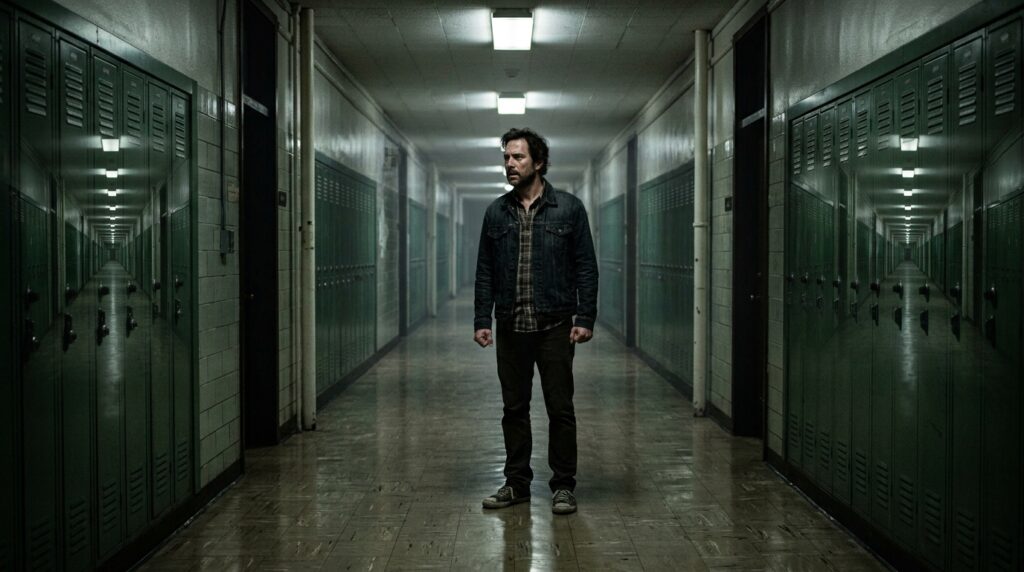
You graduated years ago. And you keep returning to school in your dreams — unprepared for an exam, lost in the corridors, unable to find your classroom. The unconscious keeps sending you back for a reason. And it is not nostalgia.
Related video: Por qué soñás que volvés al colegio aunque ya seas adulto · Published 19 August 2026 on Hidden Patterns
The exam is in twenty minutes and I cannot find the room.
The corridors are the right corridors — the ones from the school I attended between the ages of twelve and seventeen — but they have rearranged themselves in a way that makes navigation impossible. The other students seem to know where they are going. I do not. I am also, I realize with the specific dread that belongs to this dream, entirely unprepared. I have not studied. I did not know there was going to be an exam. Or I knew and forgot. Or I knew all along and could not make myself open the books.
I woke from this dream for the first time at thirty-four. I have been waking from it, in various forms, ever since. The school changes. The exam changes. The specific quality of the unpreparedness changes. What does not change is the dread — and the recognition, on waking, that I have been here before and will be here again.
Why adults keep dreaming about school is one of the most commonly reported dream themes across cultures and across the lifespan — appearing with remarkable consistency in adults who have been out of school for decades, who report no particular nostalgia for that period, and who cannot identify any obvious connection between the dream’s content and their current waking life. The unconscious keeps returning to the school not because the school is what matters. It is because the school is the setting where something that still matters was first encountered — and what the dream is processing is that something, not the setting.
Why Adults Dream About School — What the Setting Is Actually Representing
The school in the adult dream is not a memory. It is a symbol — one that the unconscious selects with surprising consistency because of what it represents: the first major social environment in which performance was evaluated, inadequacy had public consequences, and the gap between who you were and who the situation required you to be was most acutely felt.
School is where most people first encountered the specific combination that the dream reliably depicts: high stakes, public evaluation, the possibility of visible failure, and the experience of being measured against a standard that was not of your choosing and that you may not have been equipped to meet. The dream returns to that setting not because school is where the unresolved material lives — but because school is the template through which the unconscious processes any current situation that carries the same emotional signature.
The school in the adult dream is the unconscious’s preferred metaphor for evaluation anxiety — for any situation in the dreamer’s current life in which they feel unprepared, assessed, or at risk of visible inadequacy. The corridors are not the school’s corridors. They are the corridors of whatever the dreamer is navigating right now.
This is why the dream appears not in periods of genuine retrospection about school — not when the dreamer is actually thinking about that time in their life — but in periods of current pressure: before significant professional evaluations, during periods of imposter syndrome, when a new role or relationship has activated the specific fear of being found inadequate. The school is the setting. The current situation is the content. The dream is processing the current situation using the most emotionally resonant template available for evaluation anxiety that the dreamer’s history contains.
What Freud and Jung Would Each See in the School Dream
Freud’s account of anxiety dreams — dreams in which the manifest content is threatening or distressing — located their function in the processing of unresolved anxiety that the waking ego has been unable to fully address (Freud, 1900). The school dream, in this account, is the unconscious’s attempt to process evaluation anxiety by rehearsing scenarios in which the anxiety is activated — providing the ego with repeated exposure to the feared situation in a context where the consequences are not real, even if the dread is.
Jung’s account of the school dream was somewhat different — and, for many dreamers, more illuminating. Jung noted that recurring dream settings — including the school, the childhood home, and other formative environments — typically represent not memories of those settings but the psychological structures that were formed there (Jung, 1964). The school in the adult dream represents the internal evaluation system — the part of the psyche that is still applying school-era standards of performance and adequacy to current adult experience. The dream returns to the school setting because the evaluation system that was assembled in that setting is still running — still applying its criteria, still finding the current self inadequate by standards that were set decades ago.
This Jungian reading has a specific implication: the school dream is not about the past. It is about the present relationship between the current self and an internal evaluation system that was formed in the past. The exam the dreamer cannot pass is not a historical exam. It is the current standard — the internal voice that keeps finding the current performance insufficient, that keeps moving the finish line, that keeps activating the specific dread of being found inadequate in the setting where that dread was first learned.
What the Research Finds in the School Dream
Research on the most common recurring dream themes across cultures has found that examination anxiety dreams — being unprepared for an exam, failing to find the examination room, discovering one has forgotten to attend a class all semester — are among the three most universally reported dream themes, appearing with remarkable consistency across cultures, age groups, and educational systems (Yu, 2008). The consistency of the theme across contexts that differ significantly in their specific content confirms that what the dream is processing is not the specific school experience but the universal psychological template that school experiences provide: high stakes, public evaluation, and the possibility of visible inadequacy.
Research on when the school dream is most likely to occur has found that it clusters around periods of professional evaluation, significant life transitions, and imposter syndrome — the specific experience of feeling that one’s current competence or status is not genuinely deserved and may be publicly exposed as fraudulent (Hartmann, 1995). The dreamer who reports frequent school dreams is typically not someone who is thinking about school. They are someone who is currently navigating a situation that activates the same emotional signature — and whose unconscious is processing that navigation using the most available template for evaluation anxiety in their personal history.
What the Dream Is Trying to Tell You
The school dream is not telling you to think about school. It is telling you that something in your current life is activating the emotional signature of evaluation anxiety — the specific combination of high stakes, public assessment, and the fear of visible inadequacy that school first introduced as a permanent feature of social experience.
The useful question is not “what does the school mean?” but “what in my current life feels the way school felt?” What situation am I navigating right now in which I feel unprepared, assessed, at risk of being found inadequate by a standard I did not choose? What current performance is the internal evaluation system finding insufficient? And crucially: is the standard that is doing the evaluating a current, realistic standard — or is it the school-era standard, assembled in a context with different requirements, still running in a situation where its criteria no longer apply?
For the broader account of what recurring dreams are doing and why the unconscious keeps returning to the same material, see our article on why your recurring dream never stops. And for the waking dimension of what the internal evaluation system does when it keeps finding the current performance insufficient regardless of the evidence, the article on why it never feels like enough addresses the superego that the school dream is typically activating.
The Corridors Were Never the School’s
The corridors rearrange themselves because they are not the school’s corridors. They are the corridors of whatever I am currently navigating — the professional situation, the relationship, the role that has activated the specific dread of being found inadequate that school first installed as a reliable feature of my emotional landscape.
The exam I cannot pass is not a historical exam. It is the current standard — the internal evaluation system’s current application of criteria that were set in a context that no longer exists, to a situation whose requirements are entirely different. The alarm on waking is real. What it is pointing toward is not behind me. It is in front of me, in the current situation that the dream has been processing in the only template the unconscious had available for what it feels like.
References
Freud, S. (1900). The interpretation of dreams (J. Strachey, Trans.). In The standard edition of the complete psychological works of Sigmund Freud (Vols. 4–5). Hogarth Press.
Hartmann, E. (1995). Making connections in a safe place: Is dreaming psychotherapy? Dreaming, 5(4), 213–228. https://doi.org/10.1037/h0094437
Jung, C. G. (1964). Man and his symbols. Doubleday.
Yu, C. K. C. (2008). Recurrence of typical dreams and the instinct to dream. Dreaming, 18(3), 165–176. https://doi.org/10.1037/1053-0797.18.3.165
On the Channel · Published 19 August 2026
This article examines why adults keep dreaming about school — what the setting is actually representing, what Freud and Jung would each see in the dream, and what the dream is telling you about your current situation rather than your past one. The video goes deeper into the specific variations of the school dream and what each one signals about the current evaluation anxiety the unconscious is processing.→ Por qué soñás que volvés al colegio aunque ya seas adulto — Hidden Patterns
📖 If You Want to Go Further
The book that most directly addresses the psychology of recurring dream themes — including the school dream and what the unconscious is processing when it keeps returning to the same settings — is Antonio Zadra and Robert Stickgold’s When Brains Dream. Zadra and Stickgold write accessibly about the neuroscience and psychology of dreaming, what specific dream themes signal about the dreamer’s current emotional processing, and why the unconscious selects the settings it selects. It is the most current and readable account available of what school dreams — and all recurring dreams — are actually doing.