Sharp Objects is not a story about a disturbed woman. It is a story about what families do to the truth — and where the truth goes when the family has made it unspeakable.
Note on spoilers: This article discusses the full arc of Sharp Objects (HBO, 2018, dir. Jean-Marc Vallée, based on Gillian Flynn’s novel), including the ending. The psychoanalytic reading depends on the complete picture. If you haven’t seen it, the analysis will be considerably more useful after you have.
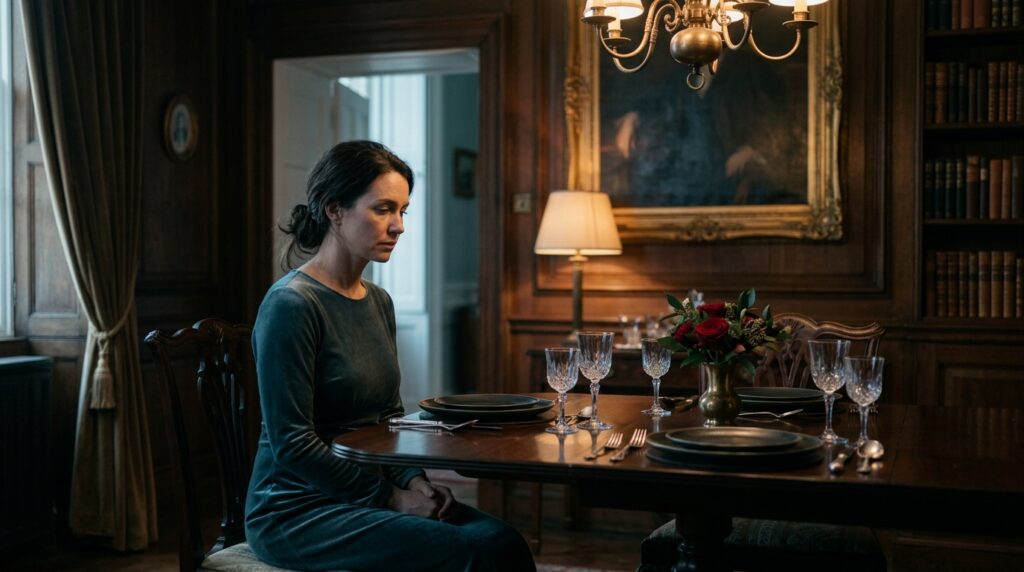
In the house I grew up in, there were things you did not say at the table.
Not because anyone had announced this. There had been no explicit instruction. The prohibition was ambient — present in the quality of silence that followed certain attempts, in the way certain subjects were acknowledged and then efficiently redirected, in the particular atmosphere that arrived when something true was allowed to remain in the room for too long.
You learned, very early, what the table could hold and what it couldn’t. And the things it couldn’t hold — they didn’t disappear. They went somewhere else. Into the body, mostly. Into a particular tension in the chest, a way of being watchful that never fully switched off, a vocabulary of physical symptoms that said the things the mouth had learned not to.
Sharp Objects is about what happens to the things that cannot be said in a particular house. It is about where they go. And it is about the cost of having housed them for long enough that the housing has become the self.
Gillian Flynn’s novel — and Jean-Marc Vallée’s adaptation — tracks Camille Preaker’s return to Wind Gap, Missouri, a town whose surface of Southern gentility barely contains the violence that the Preaker family has both perpetrated and concealed across generations. The mystery structure — two murdered girls, a journalist investigating — functions as a frame. The real subject is the family system that produced Camille, and what living inside it did to her body.
The words carved into Camille’s skin are not pathology. They are documentation. They are the record of everything that was felt and could not be spoken — the only available surface on which the truth of her experience could be inscribed without the family’s permission.
The Family System That Makes Truth Unspeakable
Wind Gap is not a town of obvious monsters. That is the point. The violence is elegant, embedded in ritual, expressed through the kind of social performance that Southern gothic fiction has always understood as the most dangerous container for what it conceals. Adora Preaker is charming, gracious, impeccably maintained. The harm she does is harm that the social world she inhabits is designed to render invisible.
The family system Sharp Objects describes is one in which the emotional truth of the children’s experience — their pain, their fear, their needs — is systematically subordinated to the requirements of the family’s self-presentation. What the children feel is not the point. What the family appears to be is the point. And the gap between the two — between what is experienced and what can be acknowledged — is the wound that the series is tracking.
In families that cannot hold the truth, the truth does not disappear. It finds another container. The body is the most available one.
Camille cuts words into her skin. Her sister Amma performs her own version of this — the perfect daughter in public, the controlled chaos of her private behaviour a direct expression of what the public performance requires her to suppress. Both are writing on their own bodies what the family system will not allow them to write anywhere else. Both are using the body as the only available site of honesty in an environment organised around the maintenance of a particular fiction.
When the Body Becomes the Archive
Freud’s account of conversion — the transformation of psychic conflict into physical symptoms — described the body as the site where what cannot be expressed in language finds expression anyway (Freud, 1905). The hysteric’s paralysis, the unexplained pain, the symptom that resists medical explanation — these are not fictions. They are, in the psychoanalytic account, the body’s vocabulary for what the mind cannot hold in words.
Bessel van der Kolk’s more recent account of how trauma is held in the body extends this in a direction that the series makes vivid. Van der Kolk describes the body as an archive of experience — storing, in muscle tension, activation patterns, and somatic symptoms, the record of what has happened to it, independent of whether that record is accessible to conscious memory (van der Kolk, 2014). The body keeps the score, as his title puts it. It does not need the mind’s cooperation to maintain the record.
What Sharp Objects shows is this process at its most extreme and most explicit. Camille’s cutting is not random. She carves specific words — the words she needs to say, the words that describe what she is experiencing, the words the family system will not permit to exist in spoken form. The body becomes the text. The skin becomes the page on which the truth is inscribed precisely because no other page is available.
The series is careful about this. It does not aestheticise the cutting or treat it as a simple symbol. It shows it as what it is: a communication system developed in the absence of any other viable means of communication — the only form of honesty that the environment, with its elaborate requirements of silence, was unable to prevent.
What the Research Finds in the Body
The clinical literature on families characterised by what Bowlby called disorganised attachment — family environments in which the caregiver is simultaneously the source of comfort and the source of fear — consistently identifies the body as the primary site of the consequences (Main & Hesse, 1990). The child who cannot turn to the caregiver for safety because the caregiver is the threat has no viable external regulation strategy. The dysregulation is driven inward, and the body becomes the container for what cannot be expressed or resolved externally.
Research on the relationship between adverse childhood experiences and somatic symptoms in adulthood has found robust associations between early family environments characterised by unpredictability, emotional unavailability, or active harm, and later presentation of unexplained physical symptoms, chronic pain conditions, and somatisation disorders (Felitti et al., 1998). The body remembers what the narrative has been required to omit.
What is particularly relevant in the Sharp Objects context is the research on alexithymia — the difficulty in identifying and describing emotional states — in individuals who grew up in families that actively suppressed emotional expression. The family that makes truth unspeakable does not only prevent its children from speaking. It impairs their capacity to identify what they are feeling at all, because the identification of a feeling is the first step toward expressing it, and the expression has been consistently foreclosed (Taylor, Bagby, & Parker, 1997).
The things you did not say at the table. The tension in the chest that said them instead. The body was not malfunctioning. It was doing precisely what it was designed to do — holding what the environment required to be held, in the only form available to it.
What the Series Actually Teaches
Sharp Objects is not, ultimately, a story about an individual woman’s pathology. It is a story about intergenerational transmission — about how families pass on not just their genes but their silences, their prohibitions, their elaborate systems of making certain truths unlivable.
Adora did not invent the system she operates within. The system was given to her. She was shaped by it before she had any capacity to recognise it as something other than the way things are. Her harm is real. Its origins are also real. Both can be true at the same time.
What changes when you see this — when you read the series as an account of family systems rather than individual pathology — is the question you ask about Camille. The question is not what is wrong with her. The question is what happened to her, and what the family system required her to do with it. The words on her skin are not evidence of disorder. They are evidence of a person who found a way to tell the truth in an environment organised around preventing it.
Understanding this does not resolve the damage. The body that learned to hold what the mouth could not say does not unlearn this easily or quickly. The archive the body keeps is not erased by the insight. But it changes what the symptoms mean — and changing what they mean changes the relationship to them. They are not a problem to be eliminated. They are a communication to be read.
The Words Are Still There
In the house I grew up in, there were things you did not say at the table. Some of them I can name now. Some of them I still find in my body first — in the tension that arrives before the thought, in the particular alertness that certain social situations produce before I have identified what they remind me of.
The body is a slower reader than the mind. It does not update as quickly when the environment changes. The archive it keeps was assembled under conditions that no longer apply, and it maintains the record faithfully regardless.
Sharp Objects ends where it had to end — with the truth finally visible, at the cost of everything the family had constructed to prevent its visibility. The truth had been there all along. In the body. In the words carved into the skin. In the particular quality of silence at a particular kind of table.
The mouth learns to stay quiet. The body keeps the record. And the record, eventually, finds a way to be read — whether or not the family ever gave it permission.
References
Felitti, V. J., Anda, R. F., Nordenberg, D., Williamson, D. F., Spitz, A. M., Edwards, V., Koss, M. P., & Marks, J. S. (1998). Relationship of childhood abuse and household dysfunction to many of the leading causes of death in adults. American Journal of Preventive Medicine, 14(4), 245–258. https://doi.org/10.1016/S0749-3797(98)00017-8
Freud, S. (1905). Fragment of an analysis of a case of hysteria (J. Strachey, Trans.). In The standard edition of the complete psychological works of Sigmund Freud (Vol. 7, pp. 1–122). Hogarth Press.
Main, M., & Hesse, E. (1990). Parents’ unresolved traumatic experiences are related to infant disorganized attachment status. In M. T. Greenberg, D. Cicchetti, & E. M. Cummings (Eds.), Attachment in the preschool years (pp. 161–182). University of Chicago Press.
Taylor, G. J., Bagby, R. M., & Parker, J. D. A. (1997). Disorders of affect regulation: Alexithymia in medical and psychiatric illness. Cambridge University Press.
van der Kolk, B. A. (2014). The body keeps the score: Brain, mind, and body in the healing of trauma. Viking.
On the Channel · Published 10 May 2026
This article reads Sharp Objects as an account of family systems and somatic truth — what happens to experience when the family makes it unspeakable, and where it goes instead. The video goes scene by scene through the series, showing how the family system operates, what Camille’s body is communicating, and what the intergenerational transmission of silence actually looks like across the Preaker women.What the body holds when the mouth learned to stay silent— Hidden Patterns
📖 If You Want to Go Further
The book that most directly addresses what Sharp Objects is about — how the body holds what the environment has made unspeakable — is Bessel van der Kolk’s The Body Keeps the Score. The chapters on how adverse childhood experiences are encoded somatically, and on the relationship between family systems that suppress emotional expression and later somatic symptoms, provide the empirical foundation for everything the series shows. It is the most important book I know on the subject of where the truth goes when it cannot be spoken.