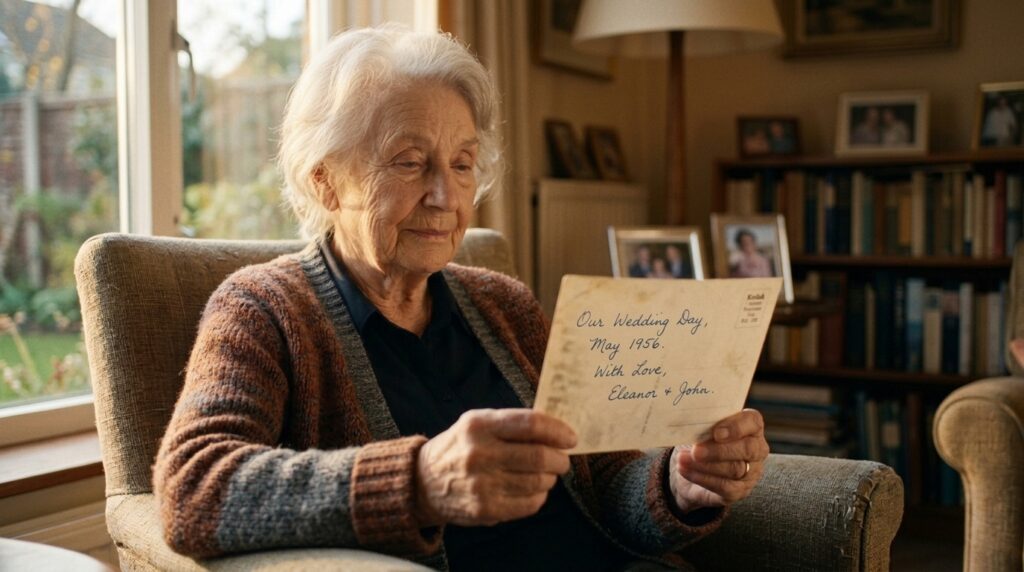
The conditional sentence that won’t close. Would it have been different if I had stayed, left, spoken, said nothing. Regret is not weakness — it is love for a version of yourself that never got to exist.
My father had a sentence he returned to in the last years of his life.
It came unprompted, usually in the middle of something else — a meal, a walk, a conversation about something entirely unrelated. He would go quiet for a moment and then say: I should have left that job in 1987. Just that. No elaboration, no visible distress, no expectation of a response. Then he would return to whatever we had been talking about, as if the sentence had simply needed to be said out loud and could now be set down.
He said it at least a dozen times over perhaps five years. I never knew what to do with it. He had built a life after 1987. A decent one. But somewhere inside the accounting of that life, 1987 remained an open question — a door that hadn’t been taken, a version of the story that had been foreclosed and that he was still, quietly, mourning.
Regret has that quality. It is remarkably patient.
The conditional sentence — would it have been different if I had — is one of the most persistent structures of thought in later life. It operates across scales: the small choices that accumulated into a direction, the large choices that foreclosed entire alternative lives, the things said and not said to people who are no longer available to say them to.
The common response to regret — from the culture, from well-meaning people, from the part of the mind that wants to resolve rather than sit with — is to argue against it. You did the best you could. You couldn’t have known. It probably wouldn’t have been better anyway. These responses are not wrong. They are also, for the person carrying the regret, largely beside the point.
The Door That Stays Open
Regret in later life has a specific texture that distinguishes it from the regret of earlier stages. The young person’s regret is usually still actionable, or at least imaginably so — there is time to correct, to try again, to find the equivalent of what was missed. The regret of later life operates in a different register. The options that were foreclosed are genuinely gone. The people who were not spoken to are sometimes no longer alive. The door is not just closed — it is no longer a door.
And yet the question persists. Would it have been different. The mind returns to it not because it expects a different answer but because something in the accounting remains unresolved. Not the facts of what happened — those are known. Something else. The feeling that a version of yourself, the one who took the other door, deserved to exist and didn’t.
Regret is not primarily about the choice that was made. It is about the self that was abandoned in the making of it.
This is the distinction that changes the relationship to the question. My father was not, at seventy-three, genuinely weighing whether he should have left that job. He was mourning a version of himself — the one who might have taken the risk, followed the thing he wanted, found out what that story was — that had been set aside in 1987 for reasons that seemed sufficient at the time and that he had never quite finished grieving.
What Was Abandoned in the Choice
Freud’s account of mourning describes it as the psyche’s work of gradually withdrawing the emotional investment placed in a lost object — accepting the loss by processing it incrementally, until the energy previously bound to what is gone becomes available for what remains (Freud, 1917). It is slow work. It requires that the loss be real to the mind, not just acknowledged intellectually.
What makes regret in later life particularly resistant to resolution is that the object of mourning is not a person or a concrete thing. It is a self — the version of the self that would have developed had the other path been taken. This self never existed. There is no memory of it to process, no relationship to withdraw from, no concrete absence to grieve. There is only the shape of what might have been, which is structurally different from a loss and therefore structurally more difficult to mourn.
Erik Erikson’s concept of ego integrity — the acceptance of one’s life as the life that was actually lived, with its particular choices and foreclosures — depends, implicitly, on this mourning work being completed (Erikson, 1968). The person who arrives at integrity has not forgotten what was not chosen. They have made peace with the fact that the life they lived precluded other lives, and that this is the condition of having a life at all rather than an infinite set of potentialities. The person still asking would it have been different has not yet completed this work. Not because they are weak or insufficiently wise — but because the mourning of an unlived self is genuinely difficult, and the culture provides almost no support for it.
What Research Finds About Regret and Time
The empirical literature on regret has identified a consistent pattern across the lifespan: the content of regret shifts over time from action regrets — things done that shouldn’t have been — to inaction regrets — things not done, paths not taken, words not spoken (Gilovich & Medvec, 1995). In later life, inaction regrets predominate, and they tend to centre on a small number of domains: education, career, romance, parenting, and the self — the sense of not having been, fully, who one could have been.
The reason inaction regrets intensify over time is partly structural. Actions, once taken, tend to generate their own accommodations — you make the best of what you chose, you find meaning in the path you took, you construct a narrative that incorporates the choice. Inactions leave no such trail. The path not taken remains hypothetically perfect, unburdened by the ordinary failures and disappointments that accompany any actual life. The unlived version of yourself never has to face what living would have required of it.
This asymmetry is important. My father’s 1987 self — the one who left the job — is preserved in the imagination in a state of perpetual possibility. He never had to find out what leaving would have actually cost, what it would have required, what it might have failed to provide. The imagined self is free of the friction that real selves accumulate. That is part of what makes it so difficult to mourn.
Grief for a Self That Never Existed
What changes when you understand regret as mourning — as grief for a version of the self that was foreclosed — is the quality of attention you bring to it.
The approach that tries to argue the regret away — it was the right choice, you couldn’t have known, it probably wouldn’t have been better — is attempting to short-circuit a process that cannot be short-circuited. Mourning is not an argument. It is not resolved by counter-evidence. It is resolved, slowly and incompletely, by being allowed to be what it is: a legitimate sorrow for something real that was lost, even if what was lost never existed in the form you imagine it.
The version of my father who left in 1987 was real enough to grieve. The feeling of its absence was real. The question of what that life might have contained was real, even if the answer was permanently unavailable. Giving the grief its proper name — this is mourning, not weakness; this is love for a self that deserved to exist — changes the relationship to the recurring sentence. It does not make it stop. But it makes it mean something other than failure.
The Question Is Also a Testament
My father said that sentence for the last time about a year before he died. I didn’t know it would be the last time. I responded, as I usually had, with something inadequate — a gentle redirection, an attempt to offer perspective. He nodded and returned to whatever we had been talking about.
What I understand now is that he wasn’t asking me to resolve it. He was saying it out loud because it needed to be said — because the version of himself that didn’t get to exist deserved to be named, periodically, in the presence of someone who would hear it. The sentence was not a complaint. It was an acknowledgement. A small act of mourning, repeated until it had been mourned enough.
Would it have been different. Probably yes, in ways both better and worse than anything the imagination supplies. The question doesn’t need an answer. It needs to be asked — seriously, with the respect that genuine loss deserves — until the asking itself becomes a form of acceptance.
He got there, I think. In his own time, in his own way. The sentence eventually stopped. Not because he had forgotten, but because something in the accounting had finally, quietly, closed.
References
Erikson, E. H. (1968). Identity: Youth and crisis. W. W. Norton.
Freud, S. (1917). Mourning and melancholia (J. Strachey, Trans.). In The standard edition of the complete psychological works of Sigmund Freud (Vol. 14, pp. 237–258). Hogarth Press.
Gilovich, T., & Medvec, V. H. (1995). The experience of regret: What, when, and why. Psychological Review, 102(2), 379–395. https://doi.org/10.1037/0033-295X.102.2.379
On the Channel
This article reads regret as mourning — as grief for a version of the self that was foreclosed. The video goes further into the emotional structure of the conditional sentence that won’t close: why it returns, what it is actually asking for, and what it means that the question persists long after any possibility of changing the answer.Would it have been different if I had…? — Hidden Patterns
📖 If You Want to Go Further
The book that takes the grief of unlived lives most seriously is Adam Phillips’s Missing Out: In Praise of the Unlived Life. Phillips — a psychoanalyst and essayist — argues that the lives we don’t live are as constitutive of who we are as the lives we do, and that the fantasy of the other path is not a distraction from living but a form of engagement with what living always requires us to give up. It is not a comforting book. It is an honest one.