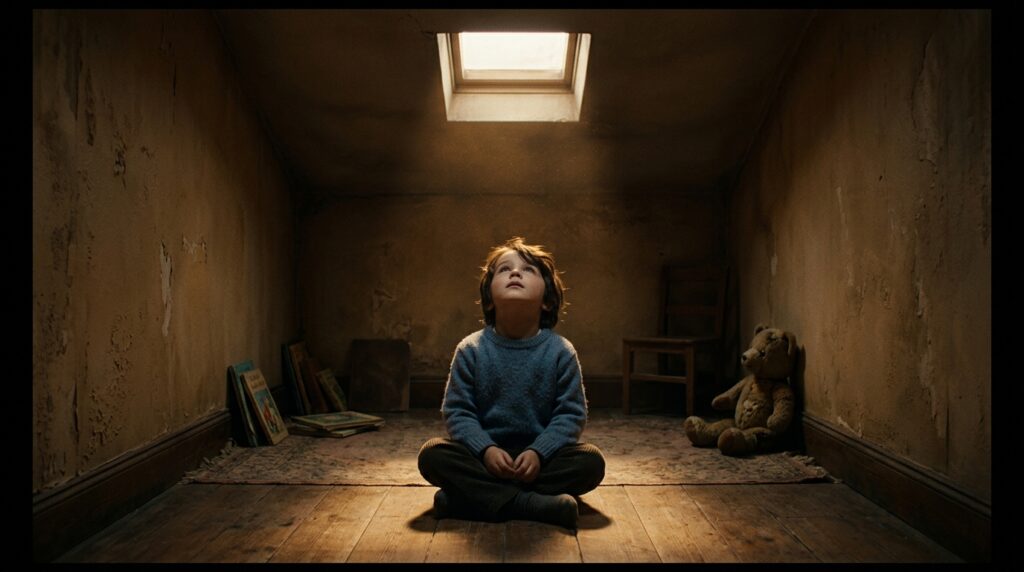
Room is not about captivity. It is about what a mind builds when the world it is given is the only world it knows — and what happens when that world suddenly expands beyond what the self was built to contain.
About the film:Room (dir. Lenny Abrahamson, 2015) follows a young woman and her five-year-old son Jack, who has spent his entire life in a single room where his mother was held captive. This article discusses the full arc of the film, including the escape and its aftermath. The second half — what happens after freedom — is central to the psychoanalytic reading.
Jack has never seen a dog that is not on television.
He has never felt wind. He has never understood that the sky is not a ceiling — that the blue above the skylight continues, in both directions, further than any room could contain. He knows his mother’s face in a way that no one who has had other faces to look at can quite know a face. He knows the room the way that people know their own bodies — completely, intimately, without the distance that familiarity usually requires.
He is five years old and he has a complete world. It is eleven feet by eleven feet. He does not know it is not enough — because he has never had more, and the mind that develops in a given environment does not register the environment as insufficient. It registers it as the world.
This is what Room is actually about.
The alarming truth Room reveals about childhood isolation is not about the captivity. The captivity is the condition — the specific, extreme version of something that exists in less dramatic forms in many childhoods. What the film is actually about is what the mind builds when it develops in a constrained environment, and what happens when that constraint is removed faster than the self that was built inside it can adapt.
This is the question the film asks: not what does isolation do to a child, but what does the end of isolation do to a self that was constructed entirely within it? The answer is psychoanalytically precise — and considerably more disturbing than the question of captivity itself.
The Alarming Truth — What the Mind Builds in a Constrained World
Jack’s world inside the room is not impoverished in the sense of being empty. It is rich — with stories, with routines, with the specific richness that total familiarity produces. He knows every surface of the room. He has named the objects. He has a relationship with the skylight that is as complex as most children’s relationships with the natural world, because the skylight is his access to the natural world — the only point of contact between his interior and whatever lies outside it.
What this points to is something that developmental psychology has established with considerable precision: the mind does not develop toward an objective external reality. It develops in relation to the environment it is actually given. The cognitive schemas, the attachment patterns, the models of how the world works that a child assembles in the first years of life — these are built from the material that is available. They are not deficient versions of schemas built from richer material. They are complete adaptations to the environment that existed.
Jack’s world inside the room is not a diminished version of the real world. It is the world — completely and accurately represented, built with the same cognitive and emotional machinery that any child uses to build their world, from the material that was actually present.
This is what makes the second half of the film so psychoanalytically revealing. When Jack and his mother escape — when the room is left behind and the actual world arrives — the problem is not that Jack’s mind is damaged. The problem is that his mind is intact. It built a complete and functional adaptation to the room. And the room is gone.
Winnicott’s Facilitating Environment — And What Happens When It Expands
Winnicott’s concept of the facilitating environment — the environmental provision that allows the self to develop without being overwhelmed by demands it is not yet equipped to meet — applies with unusual precision to Jack’s situation (Winnicott, 1965). The room, for Jack, was a perfect facilitating environment in one sense: it provided exactly what was available, with a consistency and predictability that allowed the self to develop stably within it. His mother’s presence, her attunement, her capacity to create a world of meaning within an eleven-by-eleven-foot space — these provided the relational conditions that Winnicott identified as essential for healthy self-development.
What the room could not provide was what Winnicott called graduated challenge — the progressive introduction of environmental complexity that allows the self to expand its capacity in step with its growing resources. The room was complete and consistent. It did not graduate. Jack’s self developed fully within its constraints — and then encountered a world that had not graduated either, that simply appeared all at once, in its full complexity, at the moment of escape.
The concept of impingement — Winnicott’s term for environmental demands that exceed the self’s current capacity to meet them — describes what the outside world is for Jack in the film’s second half. Not a liberation but a continuous impingement: too much, too fast, too undifferentiated, arriving before the self that was built inside the room has had the time to expand to meet it.
What the Research Finds in Extreme Early Isolation
The research on children raised in conditions of severe early deprivation — most extensively documented in the Romanian orphanage studies of the 1990s — has found that the effects of early isolation on cognitive and social development are significant and partially irreversible, with the degree of impact depending heavily on the age at which deprivation ended and the quality of subsequent care (Rutter et al., 1999). What is particularly relevant for understanding Room is the finding that even children who experienced severe early deprivation show substantially better outcomes when the deprivation ended in the context of a secure attachment relationship — when, in other words, the constrained environment contained at least one reliable source of attuned relational provision.
Jack’s developmental trajectory, within the room, was shaped by exactly this condition: severe environmental constraint combined with unusually high quality attachment provision. His mother’s capacity to remain emotionally present and attuned within her own captivity is the film’s most quietly remarkable psychological achievement. And the research suggests that this combination — constraint plus secure attachment — produces a very different developmental outcome than constraint alone.
Research on what psychologists call world expansion in previously isolated children — the experience of rapid environmental expansion after a period of severe constraint — has found that it reliably produces a specific cluster of responses: sensory overwhelm, social withdrawal, regression to earlier developmental stages, and intense distress at the loss of the familiar constrained environment (Perry, 2006). These are not symptoms of pathology. They are the predictable responses of a self that was built for one environment encountering another that it was not built for.
Jack’s distress at losing the room — his desire to return, his difficulty engaging with the expanded world, his regression in the immediate aftermath of escape — is not ingratitude, not pathology, not a failure to understand that the room was a prison. It is the accurate response of a self that lost its world. The room was his world. And losing your world, even when the world that replaces it is vastly larger and safer, is still a loss.
Why the Second Half of Room Is the More Alarming Half
Most accounts of Room focus on the captivity — the horror of what Ma endured, the injustice of Jack’s constrained childhood, the escape as the moment of resolution. The film itself is more honest than this: it locates its most psychologically complex material in what happens after the escape, when the horror is technically over and the difficulty is just beginning.
Ma’s collapse after the escape — her depression, her suicide attempt, her inability to function in the world she had been desperate to return to — is not a failure of resilience. It is the predictable consequence of a self that spent years holding everything together within an impossible constraint and then, when the constraint was removed, had no more structure to hold against. The structure was the room. Without it, the holding collapsed.
Jack’s gradual reengagement with the world — his tentative expansion from the hospital room, which became a transitional space between the room and the outside; his relationship with the dog; his growing tolerance for the sky — is a precise portrait of what Winnicott’s graduated challenge looks like when it occurs at the right pace. Not liberation all at once, but expansion in steps, each step small enough that the self can integrate it before the next one arrives.
For more on what happens to a child’s psychological development when the caregiving environment is inadequate — and how that inadequacy shapes the adult — see our article on how childhood shapes who you become. And for the specific experience of a body that carries what early confinement installs, the article on the dangerous truth Sharp Objects reveals about trauma addresses the somatic dimension of what early constraint leaves behind.
The Room Was His World
Jack, at the end of the film, asks to go back to the room. Not because he wants to be imprisoned again — he has understood by then, as much as a five-year-old can understand, what the room was. He wants to say goodbye. He wants to see it one more time as what it was: his world, the place where he developed, the environment that made him.
The scene is the film’s most psychoanalytically precise moment. Because what Jack is doing is not regression. He is doing something that the developmental literature identifies as essential for healthy transition: he is completing the goodbye to the world he is leaving before he commits to the world he is entering. He is mourning the room — which is to say, mourning the only world he has ever known — before he can genuinely inhabit the larger one.
The alarming truth Room reveals about childhood isolation is this: the mind builds its world from whatever it is given. The world it builds is complete and real and genuinely its own. And when that world is lost — even when it is lost to something vastly better — the loss is real, and the mourning is necessary, and the self that was built inside the lost world needs time and graduated expansion to become a self that can inhabit the new one.
Jack got that time. The film is wise enough to show us that he needed it.
REFERENCES
Perry, B. D. (2006). Applying principles of neurodevelopment to clinical work with maltreated and traumatized children. In N. B. Webb (Ed.), Working with traumatized youth in child welfare (pp. 27–52). Guilford Press.
Rutter, M., Andersen-Wood, L., Beckett, C., Bredenkamp, D., Castle, J., Groothues, C., Kreppner, J., Keaveney, L., Lord, C., & O’Connor, T. G. (1999). Quasi-autistic patterns following severe early global privation. Journal of Child Psychology and Psychiatry, 40(4), 537–549. https://doi.org/10.1111/1469-7610.00472
Winnicott, D. W. (1965). The maturational processes and the facilitating environment. International Universities Press.
ON THE CHANNEL · PUBLISHED 28 JUNE 2026
This article examines the alarming truth Room reveals about childhood isolation — not the captivity, but what the mind builds inside it, and what happens when that world is suddenly lost. The video goes deeper into the film’s second half: why Ma’s collapse after escape is psychologically inevitable, why Jack’s desire to return to the room is not regression but mourning, and what the research on severe early deprivation says about the conditions that produce the best outcomes.Room: what confinement does to a mind that never knew the world — Hidden Patterns
📖 IF YOU WANT TO GO FURTHER
The book that most directly addresses the neurodevelopmental account of what early isolation does to a child’s developing mind — and what the conditions for recovery look like — is Bruce Perry and Maia Szalavitz’s The Boy Who Was Raised as a Dog. Perry writes from clinical work with severely traumatized children, including children who experienced extreme early isolation, and what he documents — the specific patterns of cognitive, social, and emotional development that emerge from constrained early environments, and the graduated conditions that allow expansion — maps directly onto what Room depicts. It is the most readable account available of what Jack’s psychological experience, inside the room and after it, actually looked like from the inside.