Moonlight is not a film about identity. It is a film about shame — specifically, about what happens when shame arrives before the self has developed enough to understand what it is being ashamed of. What it reveals about shame is more precise than almost anything written about the subject.
About the film:Moonlight (dir. Barry Jenkins, 2016) follows Chiron across three chapters of his life — childhood, adolescence, and adulthood — as he navigates poverty, a drug-addicted mother, and a profound experience of shame around his identity. This article discusses the film’s full arc including its ending.
Related video: Crescer com vergonha de quem você é antes de saber o que é vergonha · Published 10 September 2026 on Hidden Patterns
The most important scene in Moonlight is not the beach scene, or the diner scene at the end.
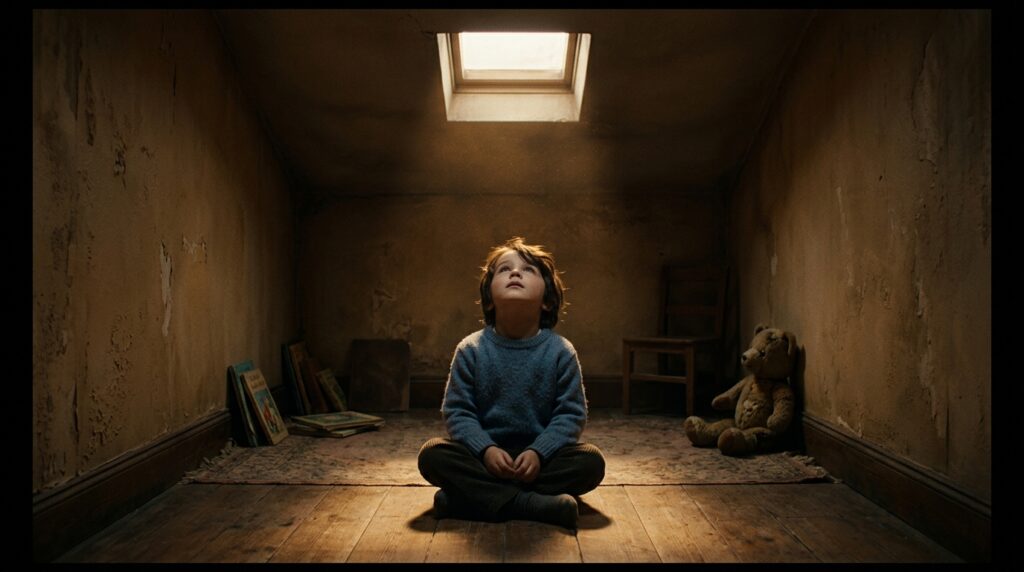
It is an early scene in which a young Chiron — seven or eight years old, small, already somehow visibly different from the other children in his neighbourhood — is being chased. He runs. He hides in an abandoned building. He sits in the dark, waiting for the danger to pass, with an expression on his face that no child should have: the expression of someone who already understands that they are wrong in some way they cannot name, that something about them is unacceptable, that the world will keep confirming this without ever explaining why.
He does not know yet what he is. He only knows that whatever he is, it is not safe to be it. The shame arrived before the identity. Before he had words for what he was, the world had already told him that it was something to hide.
The dangerous truth that Moonlight reveals about shame is not simply that shame is painful — everyone knows this. It is that shame can arrive before the self that is being shamed has developed enough to understand what it is being shamed for. This is the specific cruelty that the film documents with such precision: not shame as a response to something the self has done, but shame as the environment the self is formed inside — the medium in which the identity develops, before the identity knows what it is.
Shame That Arrives Before Identity — The Specific Wound Moonlight Documents
Psychoanalytic accounts of shame distinguish between shame as an affect — the acute experience of being seen as deficient, exposed, inadequate — and shame as a structural feature of the self that has been formed in a shaming environment. Gershen Kaufman’s account of shame as the affect that severs the interpersonal bridge — the connection between the self and the other that is necessary for the development of a coherent identity — describes the specific mechanism that Moonlight’s early chapters make visible (Kaufman, 1996).
Chiron does not experience shame as an occasional event. He experiences it as the baseline condition of his social existence — the default quality of his relationship to the world outside. Before he knows what he is, he knows that what he is produces a specific response in the people around him: withdrawal, contempt, the specific violence of children who have identified something different and are mobilizing against it. The shame is installed before the identity that it attaches to is fully formed.
The most dangerous form of shame is not the shame that arrives after the self has formed and knows what it is being shamed for. It is the shame that arrives before — that becomes part of the foundation the self is built on, so that the self that eventually develops has been organized, from its earliest layers, around the management and concealment of what it is.
This is what distinguishes Moonlight’s account of shame from more conventional representations. The shame Chiron carries is not a response to something he did. It is a response to something he is — and the something he is was perceived as shameful by his environment before he had the cognitive or emotional resources to evaluate whether the environment’s response was accurate. The child in the abandoned building is not hiding from a specific accusation. He is hiding from a diffuse, pervasive, nameless wrongness that the world keeps confirming without ever specifying.
The Three Chapters — Three Responses to the Same Wound
Moonlight’s structure — three chapters, three names for the same person, three different responses to the same foundational shame — is the film’s most psychoanalytically precise formal choice. Each chapter shows a different strategy for managing the shame that was installed in childhood, none of which resolves it.
In the first chapter — Little — the strategy is withdrawal. The child who is being chased retreats into silence, into smallness, into the specific invisibility of someone who has learned that being seen means being targeted. The withdrawal is not chosen; it is the only available response to an environment that responds to visibility with contempt. Juan’s relationship with Chiron in this chapter is significant precisely because Juan offers something the child has not encountered: genuine, non-conditional attention that does not require the child to be different from what he is. The interpersonal bridge that Kaufman describes — severed by the shame — is briefly repaired.
In the second chapter — Chiron — the strategy shifts from withdrawal to endurance. The adolescent Chiron is no longer invisible; the shame has become more specific, more named, more violently enforced by his peers. His response is to absorb it — to carry the weight of what he is without acknowledging it, to allow the bullying without fighting back, to exist in a state of sustained humiliation that is preferable, in some calculus the film does not spell out, to the alternative of fighting for a self that he does not yet know how to defend.
In the third chapter — Black — the strategy is armoring. The adult Chiron has constructed a persona — physically large, hard, occupying space in a way the child could not — that functions as a shield between the original shame and the world that produced it. The armor works in the sense that it protects. It does not work in the sense that it connects. The scene in the diner — the reunion with Kevin, the slow dismantling of the armor — is the film’s account of what it costs to have organized the entire self around the concealment of what the self actually is.
What the Film Gets Right That Most Shame Literature Gets Wrong
Most accounts of shame — clinical and popular — treat it as something that can be addressed through insight: if the shamed person can understand where the shame came from, recognize that it was not deserved, and challenge the beliefs it produced, the shame can be diminished. This account is partially accurate and significantly incomplete.
What Moonlight shows — and what Kaufman’s and Lewis’s clinical accounts confirm — is that shame that was installed before the self had developed the cognitive resources to evaluate it cannot be simply reasoned away (Lewis, 1971). It is not a belief that can be changed by being challenged. It is a structural feature of the self — embedded in the earliest layers of identity formation, present in the body as well as the mind, activated by interpersonal situations that replicate the original shaming environment before any cognitive evaluation is possible.
The repair that Moonlight suggests — tentative, incomplete, the film wisely does not overstate it — is not cognitive but relational. What begins to shift for Chiron in the diner is not his understanding of his shame but his experience of being seen, for the first time in decades, by someone who knew him before the armor and is not requiring the armor now. The interpersonal bridge is offered again. Whether it will be accepted — whether the self that was organized around concealment can risk the exposure that genuine connection requires — is the question the film ends on without answering.
For the experience of the body that carries shame without being able to name it — the physical dimension of what Chiron’s early chapters document — see our article on the dangerous truth Sharp Objects reveals about trauma. And for the account of how the false self is constructed as a response to an environment that cannot tolerate the true one — the armor that Black constructs — the article on never knowing who you are addresses the same structure from the inside.
The Shame Arrived Before the Words
He sits in the dark, waiting for the danger to pass. He does not know yet what he is. He only knows that whatever he is, the world keeps confirming that it is not safe to be it.
The dangerous truth that Moonlight reveals about shame is that this is the most damaging form it takes — not the shame that arrives after the self has formed and can at least name what it is being shamed for, but the shame that arrives in childhood, before the identity, and becomes the medium in which the identity develops. The self that forms inside this shame does not simply carry the shame as a burden. It is structured around the shame — organized, at its deepest layers, around the management and concealment of whatever produced the original response.
The three chapters show three versions of the same management strategy: withdrawal, endurance, armor. None of them resolves the shame. All of them protect the self that the shame would otherwise destroy. And the diner scene shows what is at stake when the armor is finally offered the possibility of being set down — not the resolution of the shame, but the first real encounter with another person since the shame arrived, conducted without the armor that the shame required.
References
Kaufman, G. (1996). The psychology of shame: Theory and treatment of shame-based syndromes (2nd ed.). Springer.
Lewis, H. B. (1971). Shame and guilt in neurosis. International Universities Press.
Winnicott, D. W. (1960). Ego distortion in terms of true and false self. In The maturational processes and the facilitating environment (pp. 140–152). International Universities Press.
On the Channel · Published 10 September 2026
This article examines the dangerous truth Moonlight reveals about shame — how shame can arrive before identity, what the film’s three-chapter structure reveals about the three strategies for managing foundational shame, and what the diner scene at the end is actually showing. The video goes deeper into the specific psychoanalytic account of shame as a structural feature of the self rather than a belief that can be changed by insight.→ Crescer com vergonha de quem você é antes de saber o que é vergonha — Hidden Patterns
📖 If You Want to Go Further
The book that most directly addresses the psychology of shame — its installation in childhood, its structural effects on the self, and what repair actually requires — is Gershen Kaufman’s The Psychology of Shame: Theory and Treatment of Shame-Based Syndromes. Kaufman’s account of shame as the affect that severs the interpersonal bridge — and of what it takes to repair that bridge once it has been severed — is the most clinically precise and most directly relevant to what Moonlight is showing, and reading it alongside the film produces an understanding of both that neither alone achieves.